This is default featured post 1 title

Go to Blogger edit html and find these sentences.Now replace these sentences with your own descriptions.

This is default featured post 2 title

Go to Blogger edit html and find these sentences.Now replace these sentences with your own descriptions.

This is default featured post 3 title

Go to Blogger edit html and find these sentences.Now replace these sentences with your own descriptions.

This is default featured post 4 title

Go to Blogger edit html and find these sentences.Now replace these sentences with your own descriptions.

This is default featured post 5 title

Go to Blogger edit html and find these sentences.Now replace these sentences with your own descriptions.

Thursday, 30 July 2009

The temples of Angkor Wat, Cambodia in mind


Ann told her experience and feeling in Angkor temples as well as in Siem Reap, Cambodia when she took part in an eighteen day travel through Asia with her husband.


Independent travel has been great, but after 4 months on the road all the planning and organizing was getting a bit tiresome. We booked an 18-day guided tour that would take us from Bangkok all the way through Cambodia and Vietnam with the luxury of nearly everything being planned for us.


In Bangkok we met up with our group of 11 fellow travelers, as well as our guide and a new trainee. As it turns out, everyone has been great and our group is getting along quite nicely.


The first part of our tour took us into Siem Reap, our first stop in Cambodia. Before I get any further, I’d like to go over some shocking statistics. The average age in Cambodia is 57. About 50% of the population is under the age of 18. Their literacy rate is said to be between 40-50%. And about 1/3 of their population lives on less than $1 USD per day. Another interesting fact??? 80% of all visitors to Siem Reap are either Japanese, Korean, or Chinese.


Getting from Bangkok to Siem Reap involved a 12 hour bus ride across the boarder, of which the last 160 kilometers were on a very bumpy and unmaintained gravel road. At one point our bus had to stop for repairs as we had 3 flat tires. As we crossed from Thailand to Cambodia the changes were immediate. Garbage was everywhere you looked, piled high in fields and ditches. At the boarder we had to get off the bus, walk through customs, and wait on the Cambodia side to be picked up again. Brian managed to get robbed in the first 5 minutes in Cambodia, luckily it was only his bottle of water. A young barefoot and filthy boy walked very slowly up to him, looked him in the eye for a few seconds, bent down and grabbed the bottle sitting near Brian’s feet, and ran off. Everyone in our group just watched in a combination of amusement and sadness…then clutched their belongings a little tighter.


Day two, and three, and four brought us on a guided tour of the famous Angkor Temples which were built between the 8th and 13th centuries and are spread out over about 40 miles around the village of Siem Reap. Some were in nearly complete ruin, some in the middle of restoration, and some in surprisingly great condition considering they are a tiny bit old. For you movie buffs, the Angelina Jolie movie Tomb Raider was filmed in one of the jungle temples there.


While in Siem Reap we also took a boat ride on lake Tonle Sap which is home to a floating village of houseboats, floating stores and churches, even a boat that serves as a basketball court. We did some shopping around the temples and in Siem Reap, because every few feet there are children surrounding you begging you to buy there bracelets/scarves/books /etc. We’ve also done a lot of eating - Cambodian Khmer food is very tasty.


Lots of pumpkin, coconut sauce, and fresh fruit.


So far our travels in Cambodia have surpassed our expectations. Next stop? Phnom Penh. Stay tuned…..


Author: Anne

Source: The Hallgrens’ Blog - Realtravel

They are traveling as a couple in their 30s from Belle Plaine. They decided to quit their jobs, sell their house in the suburbs, and spend time exploring the world.


Health Care to Dominate Lawmakers' Summer Recess After Quick Deal Eludes Congress


And just like that, the fast track is gone, and the push for health care reform has stepped off the bullet train.

In three days, it will be August and the start of the House's summer recess, and congressional leaders have conceded they will not approve health care reform legislation by then. President Obama says that's "OK." House Speaker Nancy Pelosi says it'll get done "whenever."


That's a big change from just two weeks ago, when it seemed the legislation was on autopilot, cruising through votes in three committees while the president and his allies predicted swift passage on the floor despite GOP opposition.

And although some members of a coalition of conservative Democrats announced a breakthrough in negotiations Wednesday, a final deal on the legislation could be a long way off, meaning August could stand as a key month before the potentially dramatic finale in the fall.

"I'm not afraid of August. It's a month," Pelosi said recently.

But August -- the Senate recess begins a week after the House breaks -- will be the first big gap in public debate since health care reform hit the fever pitch. To fill the gap, lawmakers and the president will keep pressing their case while on break.

Senate lawmakers on both sides of the aisle plan a flurry of in-person town hall meetings in their districts.

Democratic leadership aides told FOX News that their members will be hosting events across the country, while Republicans apparently are trying to match that.

Already, Republican Sens. Tom Coburn of Oklahoma and John Barrasso of Wyoming, both doctors, are hosting an educational program called "The Senate Doctors Show" to give their take on health care reform. The senators are answering questions submitted by e-mail, YouTube, Twitter and Facebook.

The "Doctors Show" is heading on the road over recess, FOX News has learned.

Meanwhile, aides will spend the summer break toiling over how to marry the Senate Finance Committee bill with elements of a more partisan bill from the Health Committee before bringing it to the floor.

It's unclear whether the Finance Committee bill even will be done by that time, though. Chairman Max Baucus, D-Mont., is trying to strike a bipartisan compromise that could produce a bill that looks substantially different from the versions that have passed out of committee. Despite signs of progress in the discussions, a Baucus aide sent a memo to staffers Wednesday saying "neither an accord nor an announcement is imminent."

Similar town halls meetings are planned for House members over August.

Under a deal announced Wednesday among the fiscally conservative Blue Dog Democrats, congressional leaders and the White House, the House will wait until September to bring the bill to the floor -- so that members can spend August combing through the massive bill and listening to the concerns of their constituents.

House Majority Leader Steny Hoyer said Tuesday there's a chance lawmakers could stay in session next week to work on a health care bill, but he called the chance "pretty slim."

"We're trying not to foreclose options," he said.

And out of the White House, Press Secretary Robert Gibbs said Wednesday that President Obama will continue to travel in August to hold town halls on health care and the economy.

The president won't be holding the kind of daily health care events he has held since last week, but Gibbs said he would be speaking out regularly on the topic during break.

With public opinion split over health care reform, the August encounters between lawmakers and their constituents could be critical, not only in keeping the American people on board with the reform push but also in shaping the course of debate once members return in September.

A Gallup poll out Wednesday showed 44 percent of Americans believe health care reform would improve U.S. medical care, while only 26 percent believe it would improve their own medical care.

The poll was conducted Friday and Saturday, based on interviews with 2,017 adults. It had a margin of error of 3 percentage points.

FOX News' Trish Turner and Chad Pergram and The Associated Press contributed to this report.


Woman in baby cut from womb case is arraigned


By HOLLY RAMER
The Associated Press
Thursday, July 30, 2009; 11:29 AM

CONCORD, N.H. -- A woman accused of cutting a baby girl from her mother's womb in Massachusetts has been arraigned on a fugitive from justice charge in New Hampshire and is being held on $2 million bail.

Thirty-five-year-old Julie Corey of Worcester, Mass., appeared in Concord District Court via video from the county jail Thursday morning, a day after she was arrested at a homeless shelter in Plymouth, N.H. She did not waive extradition to be brought back to Massachusetts. The judge scheduled a hearing for Aug. 30.

Police say she was arrested after acquaintances became suspicious of her claims that she had just given birth.

The body of the girl's mother, Darlene Haynes, was found Monday in her Worcester, Mass., apartment.

The baby was in good condition Thursday at a New Hampshire hospital.

THIS IS A BREAKING NEWS UPDATE. Check back soon for further information. AP's earlier story is below.

CONCORD, N.H. (AP) - A baby girl cut from her mother's womb in Massachusetts was in good condition at a New Hampshire hospital on Thursday, officials said, and a woman arrested at a homeless shelter with the infant was to appear in court.

Thirty-five-year-old Julie Corey of Worcester, Mass., was arrested Wednesday in Plymouth, N.H., where police found her and a man with the child at the shelter. Corey was charged as a fugitive from justice and was to be arraigned Thursday morning in district court in Concord.
ad_icon

The two used to live in the same apartment building as Darlene Haynes, the slain woman, a downstairs neighbor said. Agnes Brady said the couple moved out in the winter, before Haynes moved in.

A public records database also shows the two lived in the same building as Haynes in the past.

Brady said Corey was very friendly, and recalled her once baking a lasagna for all of the neighbors in the apartment building. Her son, Randy LaRose, said Corey had an 11-year-old son from a previous relationship who also lived in the apartment.

Corey was arrested after acquaintances became suspicious of her claims that she had just given birth, police have said.


Jackson mother 'agrees custody'


A lawyer for Michael Jackson's mother has told US TV that an agreement has been reached over the custody of the late pop star's three children.

Londell McMillan told CBS News that Katherine Jackson is to be awarded custody of Prince Michael, 12, Paris, 11 and Prince Michael II, seven.

He said Debbie Rowe, the mother of Jackson's two elder children, would have "meaningful visitation rights".

A court hearing to formalise custody is scheduled for Monday in Los Angeles.

Katherine Jackson was granted temporary custody of the children after the star's death on 25 June.

The biological mother of Prince Michael II, also known as Blanket, has never been revealed.

"It's an agreement, an agreement for the best interests of the children. This is not a money deal - this is not about money," Mr McMillan said in an interview on The Early Show.

"All of the parties are resolved - there is no situation better for these children than for them to be raised and reared in the loving care of Mrs Katherine Jackson," he said.

Custody rights

Jackson stated in his 2002 will that he wanted his mother to care for the children if he died.

Debbie Rowe gave up custody rights following her divorce from Jackson in 2000, but sought them again in 2005.

She and Jackson agreed a settlement in 2006 but the terms were never disclosed.

Meanwhile, the Los Angeles County coroner's office has said the release of Jackson's autopsy results have been delayed until next week.

The results were due to be revealed this week, amid speculation about the possible role prescription drugs played in the singer's death.

County coroner assistant chief Ed Winter did not discuss the reasons for the delay.


Obama's day: Hot dispute, cold beers


Good morning from The Oval. Exactly 90 years ago, federal troops were called out to respond to race riots in Chicago.

The patchy road of race relations has run throughout American history. Today marks a unique milepost: Beers at the White House between a president, an African-American college professor, and a white police officer who arrested the professor at his home.

President Obama, Henry Gates, and James Crowley meet at 6 p.m., at a picnic table behind the Oval Office. Obama is hoping for a "teachable moment."

Meanwhile, reactions to the Henry Gates-James Crowley flap have landed some public employees in big trouble. And the woman who made the initial 911 phone call has spoken out.

A few hours before the "beer summit," Obama meets with Phillipines President Gloria Macapagal-Arroyo.

We're not sure if the president will say anything about health care, but things are happening on Capitol Hill. House Democratic conservatives have struck a deal on a health care packages, but how will liberals react? And what about the public?

In the meantime, a series of reports show the economy is improving, while Obama says he is not anti-business.

The "cash for clunkers" program has cost the government $68.9 million so far. Check out our DriveOn blog, including Chris Woodyard's "Clunker of the Day."

The Oval will be here throughout the day and into the evening, reporting on White House beers and anything else that might happen. Have a good day -- and tonight, if you're inclined, celebrate America with a cold, frosty one.

(Posted by David Jackson; photo from Associated Press)


Wednesday, 29 July 2009

ADIos cristiano ronaldo..


salam..ayat macam biasa..'lama x update blog ni'..haha..buzy da dengan kenduri kahwin akak aku..lepak gila..hehe..gambarnya akan diupload next entri la..nak kena kumpul gambar bebanyak dulu....entri ni nak cerita pasal ronalDOh..ampeh tul..dah komfem dah mamat tu nak blah..xpe2..real madrid memang mantop la next season..dengan kaka lagi..memang fight la dengan barca..bila lak mu nak beli orang ni..komfem kena beli..dah kaya x kan x nak beli orang kot..


ang latest kot..Klaas-Jan Huntelaar..stylo gak la mamat ni..ntah la..kita tunggu je la..siapa yang jadi pengganti ronaldo season depan..huhu


yang lain2 ada gak..karim benzema dari dulu usha..x dapat2 pun.


nak cari pengganti ronaldo tu yang payah 2..kalau game xde dia..memang xde semangat nak tengok..harap2 M.U usha player yang best..speculation memang ramai..takat ni yang btul2 leh ganti ronaldo..frank ribery je..2 pn kalau M.U jadi nak beli


Nigerian 'Taliban' offensive leaves 150 dead


Islamic group opposed to western education, Boko Haram, launches attacks across four northern provinces


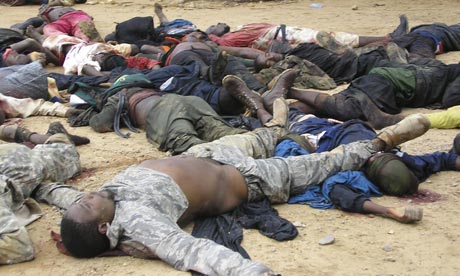
Dead Nigerians are brought to a police station in the northeastern city of Bauchi after a gun battle in the early morning. Photograph: Ardo Hazzad/Reuters

A self-styled "Taliban" intent on imposing sharia law on all Nigerians widened its offensive yesterday in violence that has left 150 people dead.

Boko Haram, an Islamic group opposed to western education, has launched attacks across four northern provinces over the last two days and declared its intention to fight to the death.

Civilians were pulled from their cars and shot, their corpses then left scattered around the streets, witnesses told the BBC. Its reporter counted 100 bodies, mostly those of militants, near police headquarters in Maiduguri, Borno state. The police and army were on patrol, firing into the air, as hundreds of people fled their homes.

Witnesses said a separate gun battle raged for hours in Potiskum, Yobe state, where members of Boko Haram chanted "God is great!" as they set a police station ablaze. Two people were confirmed dead and the police made 23 arrests.

Three people were killed and more than 33 arrested in Wudil, 12 miles from Kano, the biggest city in northern Nigeria, while the town's senior police officer was wounded.

Nigeria, Africa's most populous country, has more than 200 ethnic groups and is roughly equally split between Christians and Muslims. The predominantly Muslim north has progressively ushered in a stricter enforcement of sharia law since 2000.

Boko Haram, which models itself on the Taliban but has no known link, began its string of attacks in the northeastern city of Bauchi on Sunday after some of its members were arrested.

Around 70 militants armed with guns and grenades targeted a police station but were driven back by officers and soliders who then raided neighbourhoods, resulting in at least 55 deaths and up to 200 arrests. The Bauchi state governor imposed a night-time curfew as a result.

Ustaz Mohammed Yusuf, leader of Boko Haram, which literally means "education is prohibited", claimed that the government had been targeting his followers and they would never surrender.

He told Nigeria's Daily Trust newspaper: "What I said previously that we are going to be attacked by the authorities has manifested itself in Bauchi, where about 40 of our brothers were killed, their mosque and homes burnt down completely and several others were injured and about 100 are presently in detention. Therefore, we will not agree with this kind of humiliation, we are ready to die together with our brothers and we would never concede to non-belief in Allah."

He added: "I will not give myself up. If Allah wishes, they will arrest me; if Allah does not wish, they will never arrest me. But I will never give up myself, not after 37 of my followers are killed in Bauchi. Is it right to kill them, is it right to shoot human beings? To surrender myself means what they did is right. Therefore, we are ready to fight to die.

"Democracy and the current system of education must be changed otherwise this war that is yet to start would continue for long."

Bauchi, Yobe, Borno and Kanoare among the 12 of Nigeria's 36 states that started a stricter enforcement of Islamic law in 2000 – a decision that has alienated sizeable Christian minorities and sparked bouts of sectarian violence that has killed thousands.

Clashes in Bauchi in February killed at least 11 people and wounded dozens. A Muslim group attacked Christians and burned churches in reprisals over the burning of two mosques, which Muslims blamed on Christians.

Last November, more than 700 people were killed in two days of fighting in the central city of Jos after a disputed election triggered the worst fighting between Muslim and Christian gangs in years.

Boko Haram is not connected to the Movement for the Emancipation of the Niger Delta, the prominent rebel group responsible for a campaign of violence that has battered Africa's biggest energy sector, located in Nigeria, since early 2006.

Race row after arrest of professor


Have you heard the one about the president, the professor and the policeman?

The issue of race in the US is alive and kicking as the case of the arrest of a Harvard professor last week has highlighted.

Professor Henry Louis Gates Jr was arrested at his home after he was seen trying to force his way in to the house.

He was held for disorderly conduct after allegedly accusing the arresting officer, Sgt James Crowley, of racism.

President Obama used up political capital as he got involved in the case, saying that the police had acted "stupidily".

Things have now changed to such an extent that Sgt Crowley is being invited to the White House for a beer.


Buying a touring motorbike in Vietnam


hoto by: DON MORGAN AND STUART MCDONALD
Not-so-lonely creek: trifling obstacles such as rivers shouldn’t hold up your progress too much.

--------------------------------------------------------------------------------
Ask around if you plan to go into the remote regions of the country. there's no harm in trying your luck.
--------------------------------------------------------------------------------

The Phnom Penh Post
Wednesday, 29 July 2009
DON MORGAN

When it comes to transportation, the motorbike reigns supreme in Southeast Asia, probably because it provides a speedy, inexpensive and durable platform for travel around the region

FOR TRAVELFISH.ORG

BY far, the best way to experience Vietnam is by motorbike. As is the case elsewhere in Southeast Asia, here, the motorbike is king. They are cheap to buy, easy to repair, and they can take you places the tour bus would never dare to go.

What's more, there are no restrictions on foreigners buying motorbikes. All you need is a passport and valid visa, and you'll receive a title of ownership and a deed of transfer.

Rentals will suffice for most, but if you plan on serious bike time, buying is more economical - you can even sell the bike before you leave and recoup most of the expense.

We know the traffic seems crazy. But once you get the hang of it, you'll learn there is a method to the madness. Travel by motorbike has its dangers, to be sure, and should be undertaken conscientiously. But the vast majority of foreigners come away from their motorbike trek with nothing but great experiences to talk about back home (and maybe a few tail-pipe burns to remember them by).

You can buy a bike almost anywhere, but bigger cities will have a better selection and be more comfortable selling to foreigners. Naturally, it's best to shop around. When you settle on a bike, insist on taking it for a spin - and to a mechanic for a once over.

Your two main considerations are whether to buy new or used, and how powerful a bike you need. New Japanese and Chinese models can be purchased for as little as US$400. They should be more reliable, but then again, you may be the one stuck working out all the kinks. And you'll take a bath on the resale value.

Photo by: Don Morgan and Stuart McDonald
What happens when things go wrong.

Tuning up
We recommend a used bike. This may seem a bit daunting, and it's a good idea to make friends with a trustworthy mechanic if you can swing it.

When you buy a bike, all you're really looking at is the engine, the shocks, the wheels and the frame. If nothing's leaking or broken, and it kicks up a throaty hum when it runs, you're off to a good start. Everything else on a bike can be fixed cheaply and easily - though be sure to factor such repairs into the price you plan to pay.

In terms of power, a 100 cc bike is fine throughout most of the country, depending on the weight you intend to carry. By the time you stack two people and two full packs on it, you'll struggle up the hills even in Dalat.

Consider a clutch
Northern Vietnam is notoriously hilly and requires at least a 115cc bike. Check out the bikes used by the guys who do the Easy Rider tours, and look for something similar. If you've never driven a clutch, consider learning - it quickly becomes second nature.

Even if you buy a bike that's been restored, be sure to take it to a mechanic anyway and put some more money into it. New tires, brake drums, batteries, starters and the like are all cheap and will give you that much more peace of mind. Finally, think about where you're going to put your stuff. We got a custom-made back rack for US$6.25.

When it comes to plotting a route, we suggest planning to see more of the country by seeing less of it. You can't see everything from Sapa to Vung Tau by motorbike in a month. Pick a region - north, central, or south, and focus on that. Alternately, many buses and trains will take on a motorbike as freight for the price of an extra ticket, so you can split a trip between two regions.

Don't plan an overly aggressive route. The whole point is to take in the scenery, to stop and explore along the way. We find more than 120 kilometres in any given day starts to feel rushed. Fortunately, in thin, compact Vietnam, there is always a good option for your next stop within that distance.

It's also worth mention that, while the 'open road' in Vietnam can be breathtakingly beautiful and provide an utterly authentic experience of the country, this is Vietnam, and not all roads are open.

Try your luck
Ask around if you plan to go into remote regions of the country, especially near the borders, but there's really no harm in just trying your luck. The worst that can happen is that the police will ask you to turn around.

Final note: Wear a helmet, bring rain gear and memorise the lyrics to "Born to be Wild" before you leave. You'll be needing them.


Cambodian police arrest British man on child sex charges


Author : DPA

Phnom Penh - A British man accused of sexually abusing a 12-year-old girl has been arrested in the Cambodian coastal resort town of Sihanoukville, police said Wednesday. Gareth Ashley Corbett, 51, was taken into custody Tuesday by Phnom Penh police, said Keo Thea, Phnom Penh anti-trafficking police chief.

The arrest was reportedly made after an investigation into complaints by two girls that last week led to the arrest of US national Scott Alan Hecker, 41, in Phnom Penh.

Dozens of foreigners have been jailed since Cambodia launched a crackdown on child sex crimes in 2003.


Germany injects over $1 mln to Cambodia, Laos for fighting against hunger


PHNOM PENH, July 29 (Xinhua) -- Fearing with the continued impact by global economic crisis, the government of Germany has provided another 1.3 million euros (approximately 1.8 million U.S. dollars) to Cambodia and Laos to fight against hunger.


In a statement released Wednesday, German embassy in Phnom Penh said of the above total amount, one million euro was destined for Cambodia which is expected to help assist about one million Cambodians in 2009.


It said the fund was donated through the United Nations agency, World Food Program for its operation in this country.


The fund will help improve immediate food security and nutritional status of the Cambodian people while enhancing social stability through interventions in three priority areas: education, health and nutrition, and disaster risk reduction.

Xinhua English

In April, the U.N. Office in Cambodia issued a statement saying the country's positive trends of its economy will be slowdown after it has enjoyed over decade of increase. And less demand from foreign markets and reducing of foreign direct investment have forced a mass of people losing their jobs, such as in garment and construction sectors.


The U.N. data also indicated some 80 percent of Cambodians are living in rural areas, and where many poor families depend upon migrant remittances as their major source of income.


It is, then, citing fear that Cambodia's rural poor might adopt "unhealthy" coping measures such as reducing their number of meals per day or eating less-nutritious foods, and cutting back on health services.


Safety nets in health, education, food, and work can help break the poverty cycle, it added in the statement.


According to the World Food Program, Cambodia might need 76.3 million U.S. dollars for three years project in curbing with people in crisis.


It said the project that began in January 2008 and which is due to last until the end of 2010 has, so far, received 33 million U.S. dollars or bout 43 percent of its appeal, and that Germany has donated 2.3 million U.S. dollars or 3.1 percent of the total donated fund.

International Groups Express Concern About Cambodian 'AIDS Colony'

Main Category: HIV / AIDS
Also Included In: Public Health

In an open letter to Cambodia's prime minister and health minister, more than 100 international HIV/AIDS advocates and human rights organizations "accused the Cambodian government of herding HIV-affected families into an 'AIDS colony' outside the capital, Phnom Penh," the Guardian reports (McCurry, 7/28).

According to CNN, the letter said the "de facto AIDS colony at Tuol Sambo ... is far away from the jobs, medical facilities and support services" residents had when they lived in the city. The human rights advocates said the HIV-positive residents were moved despite repeated appeals to the government, including from the U.N. (7/28).

The groups said they are very concerned about the "life-threatening" conditions in the settlement where 40 families live in "sheet-metal sheds without running water or proper sanitation," writes the Guardian. According to the newspaper, the Cambodian government has spent the past two months moving HIV-positive people from the Borei Keila district of Phnom Penh to Tuol Sambo, "a flood-prone area 15 miles away" (7/28). In June, 20 families with HIV-positive members were evicted from their homes and moved to make way for a Ministry of Tourism garden, according to the Kaiser Daily Global Health Policy Report (6/19).

Local officials acknowledged concerns about the settlement and said they were attempting to improve conditions, reports the Guardian. "We are trying to find clean water for them," said Mann Chhoeun, Phnom Penh's deputy governor. Chhoeun added that there are plans to distribute free medicine via the Centre of Hope mission (7/28). The open letter "acknowledged the international recognition the Cambodian government has received for treating and supporting people living with HIV," CNN reports (7/28).

This information was reprinted from globalhealth.kff.org with kind permission from the Henry J. Kaiser Family Foundation. You can view the entire Kaiser Daily Global Health Policy Report, search the archives and sign up for email delivery at globalhealth.kff.org.

© Henry J. Kaiser Family Foundation. All rights reserved.
at 7:49 AM 0 comments Links to this post
Cambodian government accused of creating 'Aids colony'
http://www.mg.co.za
Jul 29 2009

Aids campaigners and human rights groups on Wednesday accused the Cambodian government of herding HIV-affected families into an "Aids colony" outside the capital, Phnom Penh.

In an open letter to the country's prime minister, Hun Sen, and the health minister, Mam Bunheng, more than 100 international and domestic pressure groups said they were "deeply disturbed" by "life-threatening" conditions at the settlement.

Forty families are forced to live in sheet-metal sheds, without running water or proper sanitation.

The government has spent the past two months moving people with HIV/Aids from the Borei Keila district of Phnom Penh to Tuol Sambo, a flood-prone area 25km away.

"By bundling people living with HIV together in second-rate housing, far from medical facilities, support services and jobs, the government has created a de facto Aids colony," Shiba Phurailatpam, of the Asia-Pacific Network of People Living with HIV/Aids, said.

Rebecca Schleifer, a Human Rights Watch spokesperson, said the conditions at Tuol Sambo posed "serious risks" to people already vulnerable to syndrome.

"People living with HIV have compromised immune systems and are especially vulnerable," she added. "For them, these substandard conditions can mean a death sentence or a ticket to a hospital."

According to Médecins Sans Frontières, conditions at Tuol Sambo do not meet international minimum standards for temporary housing.

The families were evicted from Borei Keila to make way for a commercial development, which was reportedly granted government approval on the understanding that the developer would place the residents, including those with HIV/Aids, into new housing.

The evictions continued despite protests from UN agencies, and the campaigners' letter said: "We have reason to fear that relocations of HIV-affected families are continuing even as we sign this letter."

Campaigners urged the government to stop moving families to Tuol Sambo, urgently improve living conditions there and ensure that people with HIV have access to antiretroviral drugs.

Local officials said they were aware of the concerns over the settlement and were trying to improve conditions.

"We are trying to find clean water for them," Phnom Penh's deputy governor, Mann Chhoeun, told the Phnom Penh Post, adding that plans had been made to distribute free medicine via the Centre of Hope mission.

In 2008, an estimated 67 200 adults and 3 800 children in Cambodia were living with HIV/Aids, according to UNAids. - guardian.co.uk © Guardian News and Media 2009

Tuesday, 28 July 2009

Congress pushes for healthcare deal

President Barack Obama participates in a tele-conference town hall event on health care at the AARP in Washington July 28, 2009. (REUTERS/Jason Reed)


WASHINGTON (Reuters) - Lawmakers on both sides of the Capitol pushed for a healthcare reform deal on Tuesday, with Senate Democrats near agreement with three Republicans on a plan unlikely to include a government-run insurance option backed by President Barack Obama.
In closed-door meetings and private negotiating sessions, members of Congress struggled to make progress on a healthcare overhaul before heading home for their August recess.

Democrats on the Senate Finance Committee heard an update from Chairman Max Baucus on bipartisan negotiations and said they were confident they were close to success -- even if the full panel does not manage to take up the bill before the break starts on August 7.

"Whether we get through markup or not I can't tell you today. But I am confident we'll have a concept we'll agree on," Senator John Kerry, a member of the panel, told reporters.

Obama has pushed for a measure that will rein in healthcare costs, improve care and cover most of the 46 million uninsured Americans, making it his top legislative priority.


The negotiations between three Democrats and three Republicans on the panel have zeroed in on a plan that would use nonprofit cooperatives to compete with insurers to drive down costs, members say, not the public plan favored by Obama and many Democrats.

The panel also is likely to back a tax on high-cost insurance policies to try to raise revenue and keep costs down.

The White House said it would wait until it sees the bill to comment on the cooperative approach, which is certain to disappoint some Democrats even if it wins over the three Republicans involved in the negotiations.

'NOT A NICE HISTORY'

"I have done a lot of reading on the history of co-ops and it is not a nice history," Democratic Senator John Rockefeller told reporters after the closed-door meeting of Democrats.

Obama's drive for a broad overhaul of the healthcare industry has been stalled in the Senate and House of Representatives, both controlled by his fellow Democrats. It has been hit by a deluge of criticism over the cost, scope and funding of the more than $1 trillion measure.

Republicans in both chambers have slammed the plans as an expensive first step toward a government takeover of healthcare. No Republican has come out in favor of any of the plans so far, although three Senate Republicans have worked with Baucus to find agreement.

Obama, who over the past week has lobbied hard for the overhaul plan, said there was no time to lose.

"The costs of doing nothing are trillions of dollars in costs over the next couple of decades -- trillions, not billions," Obama told a town hall meeting conducted by AARP, a lobbying group for seniors.

"I understand people being scared that this is going to be way too costly," he said. "It's not too costly if we start making changes right now."

An August deadline to approve initial versions of the bill is dead in the Senate and endangered in the House, where conservative Democrats have blocked its passage in the last of three House committees that must consider the bill.

The so-called "Blue Dog" Democrats complained the cost savings are inadequate in the bill and blocked a vote in the House Energy and Commerce Committee. They met late into the night on Monday with panel chairman Henry Waxman without agreement.

Each chamber hopes to get bills passed in the last remaining committee before heading home. The House leaves for its break on Friday.

"We're very optimistic that both the Senate Finance Committee and the House Energy and Commerce Committee -- that is the third of the House committees -- will finally finish working on their legislation," said Linda Douglass, a spokesman for the White House Office of Health Reform.

"That means that all five congressional committees will have put forth legislation. There will be legislation you can take a look at," she said.

House Democratic Leader Steny Hoyer said so far he saw no reason to hold lawmakers back from the recess for more work on the bill, but he said there were "ongoing positive discussions" with the Blue Dogs. "I think the Blue Dogs want to get there," Hoyer said.

(Additional reporting by David Alexander, Rick Cowan and Jackie Frank; Writing by John Whitesides; editing by Vicki Allen)

Lawyers Say They Are ‘Free’ To Defend

By Men Kimseng, VOA Khmer
Original report from Washington


Opposition lawmaker Mu Sochua faced the court over her defamation suit with the prime minister on Friday without a lawyer. After her first attorney quit—facing defamation charges himself—she was unable to find another, she said, due to “political pressure.”

Cambodian lawyers say they are free to represent the clients they want, but Mu Sochua’s case has underscored the entanglement of politics and the court that critics say stops the judiciary from being independent.

“There is no problem as long as the client approaches us,” said Cambodian attorney Poeung Thida. “We just puck up a client we feel we want to defend. If we don’t want it, we just don’t take the case. This is our free will.”

In Mu Sochua’s case, her first attorney, Kong Sam Onn, quit after he was countersued by Prime Minister Hun Sen and was put under investigation by the country’s bar association. His case was dropped after he apologized to Hun Sen. (Kong Sam Onn declined to comment, saying he left because of a “personal issue.”)

Mu Sochua defended herself with a brief statement to the court, in a case that is to be decided on Aug. 4.

Chiv Song Hak, president of the 647-member bar association, said lawyers in the country have “enough freedom” to make their own choices.

“The law does not restrict them to only representing this client and not the other,” he said. “Our code of conduct only states that a lawyer has the right to decline a client they don’t want to represent.”

Mu Sochua, a US-Cambodian citizen and deputy secretary-general for the Sam Rainsy Party, said she did not agree.

“How can a lawyer do his job if they still feel scared?” she asked. “They still feel that they will become a victim like my lawyer, Kong Sam Onn. I see that professional lawyers are vulnerable to political pressure.”

Mu Sochua had also sought legal counsel from the Cambodian Defenders Project, but the head of the organization, Sok Sam Oeun, said his group defends the poor.

“She has enough money to hire a lawyer,” he said of Mu Sochua. “And so far as I know, there are many lawyers in the Sam Rainsy Party. To say that there is no lawyer willing to represent her is unreasonable.”

Cambodia Angkor Air plans flights to Viet Nam


PHNOM PENH — Deputy Prime Minister Truong Vinh Trong and Cambodian Prime Minister Hun Sen yesterday cut the ribbon launching the new Cambodian national airline, Cambodia Angkor Air (CAA), a joint venture between Viet Nam and Cambodia, at Pochentong International Airport in Phnom Penh.


CAA is a joint venture between the Cambodian National Aviation Agency and the Vietnam Airlines Corporation.


CAA has two ATR-72-500 aircraft that service domestic flights from Phnom Penh to Sihanoukville and Siem Reap.


It has plans to expand its operations to other regional countries, including Viet Nam and Thailand, with A-320 and A-321 aircraft.


Cambodia’s national airline, Royal Cambodge Airlines (RCA), was established in 1994, but had to close operations in 2001 due to huge losses and the use of planes that did not meet the International Civil Aviation Organisation’s standards.

Share

Twitter Delicious Facebook Digg Stumbleupon Favorites